

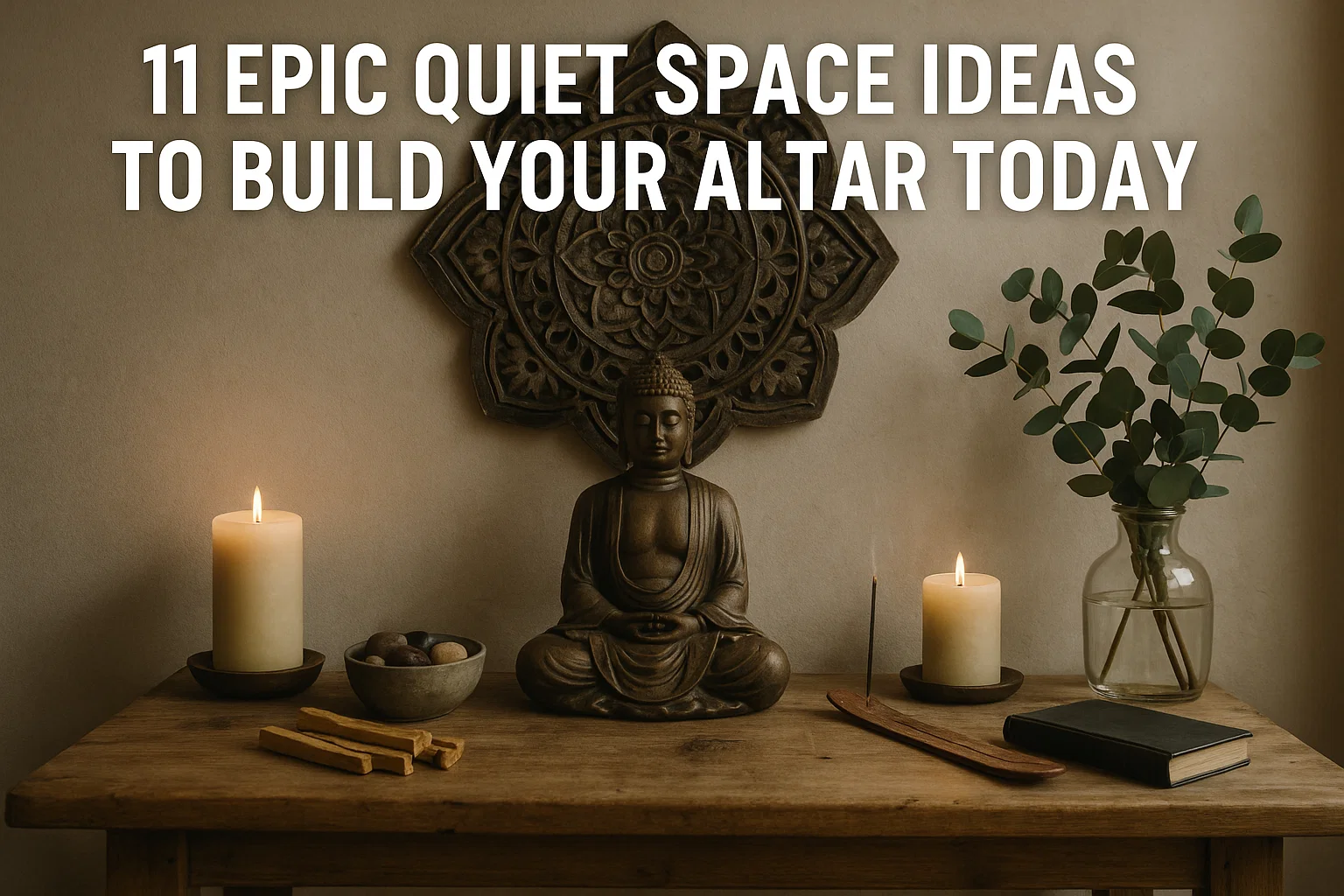
The noise doesn’t stop. It wasn’t one big explosion that broke me; it was the hum. The constant, low-level electric buzz of expectations, emails, traffic, and the notification chime on my phone that sounds harmless but started to feel like a needle to the neck. I remember standing in my kitchen on a Tuesday night, staring at a pile of mail I didn’t want to open, feeling like a wire pulled so tight it was vibrating. I wasn’t sad. I was frayed. I didn’t need a vacation to a beach where I’d just stress about work while holding a margarita. I needed a bunker. I needed a sanctuary within the four walls I was paying a mortgage on.
That desperation forced me to look at my house differently. I stopped seeing rooms and started seeing potential escape hatches. This journey led me to discover quiet space ideas to build your altar, and I’m not exaggerating when I say it saved my sanity.
We tend to get weird about the word “altar.” It conjures up images of dusty cathedrals or intense rituals that feel foreign to a regular guy just trying to lower his blood pressure. But strip away the mysticism for a second. In the context of your living room or garage, an altar is just a battery charger. It’s a physical location anchored in reality that signals your brain to shut up and listen.
Also read: Mantra Lists To Chant For Deep Peace and Sitting Tips To Meditate Without Pain
Key Takeaways
- Space is a Mindset: You don’t need a spare wing of the house; you need intention and a 3×3 foot square.
- Personalization is Power: Your altar should look like your soul, not a page from a glossy design catalog.
- Nature Heals: A real rock or a living plant grounds you faster than any plastic decoration ever could.
- Consistency Matters: The magic isn’t in the furniture; it’s in the habit of sitting there.
- Flexibility is Key: If you move, the altar moves. It travels with you.
Why Do We Crave a Personal Sanctuary in a Loud World?
You might be asking yourself, “Can’t I just sit on the couch and close my eyes?”
Technically, yes. But be honest with yourself. When you sit on the couch, what does your body expect? It expects Netflix. It expects scrolling through social media. It expects a beer. Our brains are association machines. We map behaviors to environments. The kitchen means food. The bed means sleep (or insomnia). The office means stress.
We need a trigger for peace.
I found that without a designated spot, my attempts at “quiet time” were pathetic. I’d try to meditate in the living room, but my eyes would drift to a stain on the rug or a stack of magazines that needed sorting. My brain wouldn’t downshift. Creating a specific zone dedicated to silence tells your nervous system, “Okay, we are safe here. We are off the clock.”
This isn’t magic. It’s biological engineering. By exploring specific quiet space ideas to build your altar, you are hacking your own fight-or-flight response. You are building a physical off-switch for your stress.
Can a Tiny Corner Really Transform Your Mental State?
Let’s smash the biggest excuse right out of the gate: “I don’t have room.” You do not need a sprawling “meditation room” with teak floors and a skylight. In fact, some of the most powerful spaces I’ve ever built were the smallest. A small space acts like a container. It holds you together when you feel like you’re spilling out all over the place.
1. The Walk-In Closet Conversion
I have to start with this one because it’s where I started. I was living in a cramped two-bedroom apartment with a roommate who thought “quiet hours” were a suggestion, not a rule. Peace was a fairy tale.
I had a small coat closet in the hallway. It was a graveyard for winter coats I hadn’t worn since 2012, a vacuum cleaner with a busted belt, and a tangled mess of extension cords. One Saturday, fueled by pure frustration, I gutted it. I threw the junk in the trash or donated it.
I painted the inside a deep, matte charcoal—almost black. I tossed a single thick cushion on the floor and mounted a low shelf at eye level. That was it.
When I shut that door, the apartment disappeared. The noise of the TV was muffled. It was dark, cool, and smelled faintly of the cedar block I’d thrown in the corner. That tiny, dark box became my cockpit. I would sit there for twenty minutes before work, just breathing in the dark. If you are tight on space, look at your closets. Can you consolidate? Can you claim that tiny square footage? It changes the game completely.
2. The Window Ledge Lookout
Maybe the “cave” vibe isn’t for you. Some of us need expansion, not containment. Light plays a massive role in how we process heavy emotions. If you’re feeling trapped, looking into the dark might make it worse.
Do you have a window? Even a small one?
I set up a temporary altar on a windowsill in my kitchen. It overlooks a scraggly tree and a bit of the neighbor’s roof. Not exactly a mountain view. But watching the light change on the leaves, or seeing a bird land for a split second, pulls you out of your internal loop.
Use the ledge itself. Place a resilient plant, a heavy candle, or a photo of a mentor who had their act together. This setup integrates the outside world with your inner world. It reminds you that the world is big, and your current headache is small.
How Does Nature Play a Role in Grounding Us?
We spend 90% of our lives indoors. We live in boxes, drive in boxes, and work in boxes. We breathe recycled air and bathe in fluorescent light. It wears on a man. It disconnects us from the rhythm of things. Bringing the outside in isn’t just decoration; it’s a necessity for lowering cortisol.
3. The Botanical Haven
I visited a buddy of mine, Mike, a few months back. Mike is a high-frequency trader—a guy who lives and dies by the second. I expected his place to be chrome and glass. Instead, I walked into a corner of his living room that looked like a greenhouse exploded.
He had arranged three large floor plants—snake plants and monsteras, the unkillable kind—in a tight semi-circle. In the center was a beat-up leather cushion. “The plants block the view of the TV,” he told me. “When I sit there, all I see is green. I smell the dirt.”
Plants do double duty. They physically screen off the rest of the room, creating privacy without building walls, and they clean the air. Sitting among living things reminds you that life moves at a biological pace, not a digital one. If you want robust quiet space ideas to build your altar, start at the garden center. Buy something you can’t kill.
4. The Elemental Rock Garden
Maybe you have a black thumb. I’ve killed succulents, which is apparently impossible. If plants aren’t your thing, turn to stone and water.
I built a small tabletop altar recently using river rocks I collected on a hiking trip. I didn’t buy them in a bag; I picked them up out of a cold stream. I arranged them in a circle on a heavy wooden tray. In the center, I placed a small, recirculating fountain I bought online.
The sound of trickling water is a powerful white noise. It masks the sound of traffic or the refrigerator humming. But more than that, handling the rocks—feeling their weight, their cold temperature, their roughness—is a tactile grounding technique. It pulls you out of your head and into your hands. It’s rugged, simple, and requires zero watering.
What If You Have Zero Extra Room in Your Apartment?
This is the most common objection I hear. “I live in a studio,” or “My kids have taken over every inch of the floor with Legos.” I get it. Space is the ultimate luxury. But your altar doesn’t have to be a permanent fixture that takes up precious floor space.
5. The Portable Altar Box
Think of this as your “spiritual go-bag.” I traveled for work for about two years straight, living out of suitcases in generic hotel rooms that all smelled like industrial cleaner. I felt unmoored. Drifting.
I started carrying an old cigar box. Inside, I kept a stick of high-quality incense, a small iron statue of a bear (my totem animal), a heavy lighter, and a handwritten note with my core values on it.
In every hotel room, I’d clear the nightstand, open the box, and set up my station. Instantly, that sterile room felt like my territory. When I was done, I packed it up and slid it under the bed. The ritual of unpacking and packing becomes part of the practice. It signifies the beginning and end of your quiet time. It’s stealthy and effective.
6. The Vertical Wall Shrine
When floor space is at a premium, you have to go up. Floating shelves are your best friend here.
I installed three small floating shelves in a vertical column on a narrow strip of wall between my bedroom door and the closet. It was dead space. Now, it’s a shrine.
The top shelf holds a visual focus point—a black and white photo of a landscape I love. The middle shelf holds my tools—matches, a small bell, a rosary. The bottom shelf is empty. It waits for a daily offering or just remains void. You don’t sit on this altar; you stand before it, or you pull a chair over when you need it. It takes up zero square footage but claims the vertical space, drawing the eye upward and elevating the energy of the room.
Is It Possible to Find Peace in the Garage or Shed?
Here is where we get a little unconventional. Who says an altar has to be inside the house with soft cushions and Enya playing in the background? That’s not for everyone.
7. The Workbench Altar
I love working with my hands. There is a specific kind of meditation that happens when you are sanding wood or wrenching on an engine. My garage is chaotic—tools everywhere, sawdust, oil stains on the concrete. But I cleared a two-foot section on the far end of my workbench.
I laid down a clean piece of thick leather. On it, I placed a framed photo of my grandfather (who taught me how to swing a hammer) and a single, perfectly machined steel cube.
Before I start a project, I stand there. I touch the steel. I look at the old man. I set my intention to work with focus and patience, to measure twice and cut once. It grounds me. It stops me from rushing and making stupid mistakes. Your quiet space ideas to build your altar can be rugged. They can smell like sawdust and gasoline. If that is where you feel most yourself, that is where your altar belongs.
How Can Lighting Define Your Sacred Boundary?
You cannot ignore lighting. Overhead lighting is the enemy of relaxation. It triggers wakefulness and anxiety. It reminds you of the office.
8. The Candlelight Circle
This is one of the most accessible ideas on the list. You don’t even need a permanent furniture arrangement. You just need fire.
Buy five or six tall pillar candles. Get the unscented ones; you don’t need a headache from synthetic vanilla. Arrange them in a loose semi-circle on the floor. When you sit in the middle, you are literally surrounded by fire.
Turn off all the electric lights. The flickering flame creates a primal, hypnotic focal point. We have been staring into fires for a million years; it’s hardwired into us to relax when we see low, warm light. The boundary of your altar is defined not by walls, but by the edge of the candlelight. It is incredibly effective for late-night decompression.
Do You Need Religious Icons to Build a Spiritual Space?
Absolutely not. Unless you are deeply religious, putting a statue you don’t understand on your altar feels fake. An altar is a reflection of what you value, what you aspire to, or what you want to remember.
9. The Ancestor or Memory Corner
We often lack connection to our past. We live in the eternal “now,” scrolling through feeds that disappear in 24 hours. Creating a space dedicated to those who came before us anchors us in a timeline longer than our own stress.
I have a small shelf dedicated to the men in my family who have passed. A watch from my dad that stopped working in 1998. A pocket knife from my uncle. A blurry black and white photo of my great-grandfather standing in front of a Ford Model T.
Spending time here isn’t about worshipping them; it’s about consulting them. “What would the old man do in this situation?” It forces you to step back and look at your life through a generational lens. It provides perspective that Netflix never will. It reminds you that you are part of a chain.
10. The Minimalist Void
Sometimes, the best thing to put on an altar is absolutely nothing.
We are bombarded with visual clutter. Advertisements, screens, mess, branding. A powerful quiet space idea to build your altar is to create a zone of absolute emptiness.
Find a white wall. Place a white cushion. Have a small, low white table. Put nothing on it.
The discipline of keeping that surface empty is the practice. Every time you are tempted to leave a coffee cup, a book, or your keys there, you stop. You protect the emptiness. Sitting before a void invites your mind to empty itself. It is challenging. It’s uncomfortable at first. But it clears the cache in your brain better than anything else.
Can Technology and Silence Coexist in Your Sanctuary?
This is a tricky one. Usually, I’d say banish the phone. Throw it in the other room. But technology can be a tool if used with strict, military-grade discipline.
11. The Audio-Immersive Zone
If you live in a noisy city where thin walls mean you hear your neighbor’s arguments or the bus braking outside, silence might be physically impossible. You have to manufacture it.
Your “altar” here consists of a high-quality pair of noise-canceling headphones and a dedicated, comfortable chair. This chair is only for listening.
You do not scroll Instagram here. You sit, you put on the headphones, and you play binaural beats, rain sounds, or deep brown noise. The technology creates the walls that the architecture couldn’t provide. You are building a sonic cathedral.
Integrating the Practice: How to Actually Use These Spaces
Building the space is only 10% of the battle. It’s the fun part. The other 90% is showing up when you don’t feel like it.
I remember when I finished my closet conversion. I was so proud of the paint job. I sat in it once, took a picture for social media (ironic, I know), and then didn’t go back in for three weeks. It became just another storage space for a cushion.
An altar is like a muscle. It only gets stronger when you exercise it.
- Start Small: Do not commit to an hour a day. You will fail. Commit to three minutes. Walk to your spot, light the candle, take ten deep breaths, blow the candle out. Done.
- Anchor It: Attach the habit to something you already do. “After I brush my teeth, I sit at the altar.” “Before I pour my coffee, I touch the altar.”
- Protect It: Do not let the altar become a dumping ground for mail, laundry, or toys. The moment you place a utility bill on your altar, you have desecrated the energy. You have let the stress invade the sanctuary. Defend that boundary aggressively.
The Subtle Art of Object Selection
What you place in these quiet space ideas to build your altar matters. Every object should earn its rent. If it doesn’t serve a purpose, it’s clutter.
Ask yourself: Does this object make me feel calm, strong, or inspired? If the answer is “meh,” get rid of it.
- Scents: Smell bypasses the logic center of the brain and hits the emotional center directly. Pine, cedar, and sandalwood are great for grounding. They smell like the woods. Lavender is good if you want to sleep.
- Textures: We are starved for texture in a world of smooth glass screens. Smooth stones, rough bark, soft velvet, cold metal. Engage your hands. Give them something real to hold.
- Written Word: A single index card with a mantra (“Keep Going”) or a quote is better than a whole bookshelf. Change it weekly so you don’t stop seeing it.
Navigating the “Man Cave” vs. “Altar” Dynamic
As a guy, I struggled with the word “altar” initially. It felt soft. It felt like something that didn’t belong to me. I tried to frame it as a “strategy room” or a “decompression zone.”
Call it whatever you want. But understand the difference between a Man Cave and an Altar. A Man Cave is usually about distraction—TVs, video games, beer, darts. It’s about checking out. It’s about numbness.
An altar is about checking in.
You go to the Man Cave to escape reality. You go to the altar to face reality with a clearer head. You can have both. I have both. But don’t confuse them. One numbs the pain; the other heals the injury.
Final Thoughts: Just Build the Damn Thing
You don’t need permission. You don’t need to be a “spiritual person” who burns sage and owns crystals. You just need to be a human being who recognizes that the noise is unsustainable.
Look around your home right now. Look at that awkward corner where nothing fits. Look at that messy shelf in the hallway. Look at that garage workbench covered in grime.
There is potential there.
Implementing any of these quiet space ideas to build your altar is an act of rebellion. You are rebelling against the chaos of the modern world. You are driving a stake into the ground and saying, “This square footage is mine. This is where I come back to myself.”
It doesn’t have to be perfect. It just has to be yours. Start today. Clear the shelf. Drop the cushion. Light the flame. The silence is waiting for you.
For more deep dives into how our physical environments shape our mental health, check out this excellent resource from the University of Minnesota.
FAQs – Quiet Space Ideas To Build Your Altar
What is the purpose of creating a quiet space or altar in my home?
Creating a quiet space or altar in your home provides a designated trigger for peace, helping your nervous system recognize a safe environment for relaxation and mental clarity in a noisy world.
How much space do I need to build an effective altar?
You only need a small, intentional area, such as a 3×3 foot square, to create a meaningful altar that can significantly impact your mental state.
Can I build a quiet space in a small apartment or limited space?
Yes, even in a small apartment, you can convert closets, use window ledges, or employ vertical space, such as floating shelves, to create a personal sanctuary within limited space.
What are some simple and affordable ideas for building my altar?
Simple ideas include using a small closet as a dark retreat, placing a plant or rock on a window ledge, assembling a portable altar box, or setting up a candlelight circle on the floor.
How important is consistency in maintaining my quiet space or altar?
Consistency is crucial; regular use of your altar develops the habit and strengthens its calming effect, turning it into an effective tool for managing stress and finding mental clarity.