
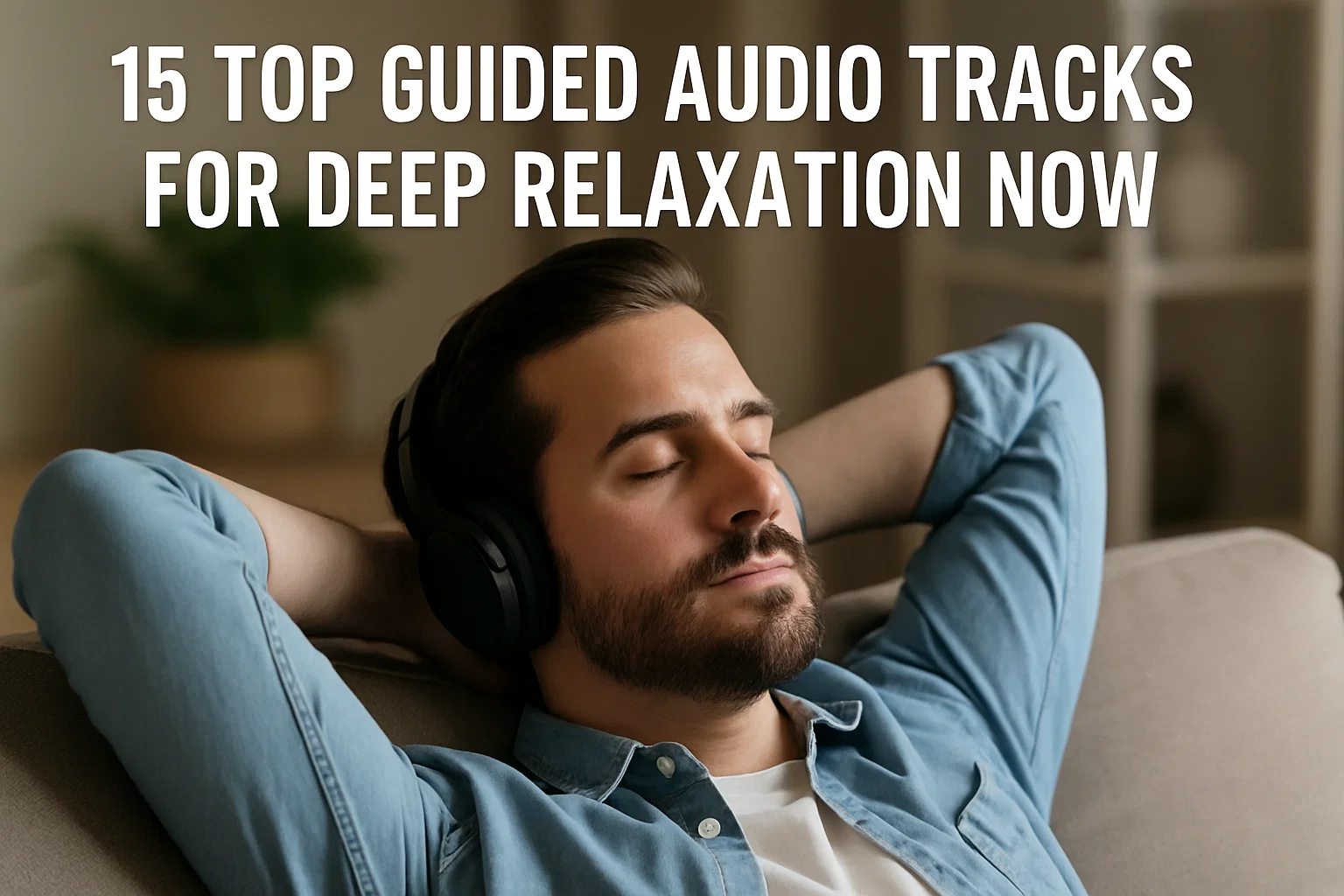
It was 2:00 AM on a Tuesday, and I was staring at a water stain on the ceiling that looked suspiciously like a map of Florida. My chest felt like I’d swallowed a brick. The double shift was over, the house was quiet, but my brain was still running marathons. I wasn’t just tired; I was wired, that nasty combination where your body screams for rest but your mind refuses to sign the paperwork. That’s when a buddy of mine—a guy who usually mocks anything “zen”—texted me a link. I clicked it, shoved in my earbuds, and waited to roll my eyes.
I didn’t get the chance. Ten minutes later, I was out cold.
That night changed my playbook. I realized that guided audio tracks for deep relaxation aren’t just for people who own yoga studios or drink kale smoothies. They are practical, tactical tools for regular guys who need to switch off the noise. In this article, I am sharing the specific tracks that actually work. No fluff, no crystals—just the audio that gets the job done in late 2025.
Also read: Silent Mind Hacks To Stop Overthinking and Focus Tips To Stay Present In The Moment
Key Takeaways
- It’s Biology, Not Magic: These tracks hack your nervous system, flipping the switch from “fight or flight” to “rest and digest” faster than you can do it alone.
- Real Experts Only: I’ve skipped the amateur YouTube channels in favor of tracks from clinical psychologists and seasoned pros.
- Something for Every Crisis: Whether you need to sleep, stop a panic attack, or just reset at lunch, there is a specific tool here for you.
- Free and Accessible: You don’t need an expensive subscription for most of these; many are hosted by top-tier universities.
Why Can’t I Just Relax on My Own?
Ever notice how you can’t tickle yourself? It’s kind of the same principle. When you are spinning out, your internal voice is the one causing the problem, so it can’t be the one to fix it. You need an external regulator. You need a voice that isn’t yours to cut through the static.
I used to think meditation was about emptying your mind, which sounded impossible. But guided audio tracks for deep relaxation give your brain a job to do. You focus on the voice, the instructions, the imagery. It distracts the analytical part of your brain just long enough for your body to catch up. Research from places like Stanford and Bangor University backs this up—listening to guided imagery drops cortisol levels measurably. It effectively hijacks your body’s stress response and forces a reboot.
Which Sleep Tracks Will Actually Knock You Out?
Sleep is the first thing to go when life gets heavy. I’ve spent years testing tracks for those nights when the insomnia hits hard. These five are the heavy hitters.
1. “Body Scan for Sleep” by UCLA Mindful
This is the one I go to when my legs feel restless and my shoulders are up by my ears. It’s not poetic; it’s practical. The narrator walks you through a systemic shutdown of your physical body, muscle group by muscle group. It runs about 13 minutes, which is the sweet spot. You can find it right on the UCLA Health website without paying a dime. It’s clinical, clean, and incredibly effective at dropping your heart rate.
2. “Blue Gold” from Calm
Look, I didn’t think I’d be the guy falling asleep to a bedtime story, but here we are. Stephen Fry narrates this one, and the man’s voice could soothe a angry badger. He describes a journey through lavender fields in Provence. The sensory details are so thick you can almost smell the flowers. I’ve started this track dozens of times and honestly couldn’t tell you how it ends. I’m usually gone by the time we get to the village.
3. “Yoga Nidra for Sleep” by Jennifer Piercy (Insight Timer)
Yoga Nidra is different. They call it “yogic sleep,” but I call it a brain bath. Jennifer Piercy’s track on Insight Timer is legendary for a reason. It guides you into that weird, floaty space between being awake and asleep. It’s perfect for those nights when you are totally exhausted but your mind is racing at a million miles an hour. You don’t have to “do” anything; you just lie there and let the audio wash over you.
4. “The Sleepy Sloth” by New Horizon
Yeah, the name sounds childish. Get over it. Sometimes your brain needs to be treated like a toddler to calm down. This track bypasses your cynical adult defenses with gentle, playful imagery. I played this for my nephew when he was crashing at my place, and I ended up passing out on the floor before he did. If serious meditation tracks make you feel anxious, try this. It’s disarming in the best way.
5. “Rainday Antiques” from Headspace
This is a “Sleepcast,” which is cool because it changes slightly every time you listen. That stops your brain from predicting what comes next. It mixes the sound of rain—which is biologically soothing—with a tour of a dusty, cozy antique shop. It triggers that safe, warm feeling of being indoors during a storm. It’s auditory comfort food.
What Are The Best Tracks For Panic and Acute Anxiety?
There is a difference between needing sleep and needing to stop a panic spiral. When the walls start closing in, you need something punchy and immediate.
6. “Three Step Breathing Space” by Bangor University
I keep this saved on my phone for “break glass in case of emergency” moments. It’s under four minutes. I’ve used it in parked cars, bathroom stalls, and stairwells. It uses a three-step protocol—awareness, gathering, expanding—to ground you instantly. It doesn’t ask you to be happy; it just asks you to be here.
7. “Meditation for Working with Difficulties” by UCLA Mindful
Most guys I know try to ignore stress until it explodes. This track forces you to do the opposite. You turn toward the bad feeling. It sounds counterintuitive, but it works. The guide has you locate the physical sensation of the emotion—the knot in the stomach, the tight throat—and breathe into it. It stops the emotion from turning into a catastrophe.
8. “The Center of Now” by Tara Brach
Tara Brach is the real deal. Her late 2025 track, “The Center of Now,” is brilliant because her voice carries zero judgment. She makes you feel like it’s okay to be a mess. The track focuses on “awakening through the body,” helping you drop the story you are telling yourself about why you’re anxious and just feel the raw sensation. It cuts the feedback loop of worry.
9. “SOS Meditation” by Headspace
This is for when you are at a 10 on the panic scale. The pacing is faster than a sleep track because it needs to catch a racing mind. I used this after a near-miss on the highway once. My hands were shaking, and I couldn’t think straight. This track talked me down from the ledge in under ten minutes.
10. “Five-Finger Relaxation” by Dartmouth Student Wellness
This is an active one. You use your hands. You touch each finger with your thumb while associating it with a specific relaxing thought. I love this because it gets you out of your head and into your physical body. Once you learn the technique from the audio, you can do it during a meeting under the table without anyone knowing.
Can You Find Deep Relaxation in Under 10 Minutes?
“I don’t have time” is the biggest lie we tell ourselves. You don’t need an hour. You need a few minutes of intentionality.
11. “Brief Mindfulness of Sounds” by Oxford Mindfulness Foundation
This one is cool because it doesn’t ask you to block out the world. Instead, you focus on the noises around you. I do this one while walking the dog. You stop labeling noises as “annoying construction” or “loud traffic” and just hear them as sound waves. It turns a chaotic city street into a weirdly calming symphony.
12. “6-Minute Breathwork” by Breathwrk
Sometimes you can’t think your way out of stress; you have to breathe your way out. This isn’t meditation; it’s biology. The app guides you through rhythmic breathing that physically forces your heart rate to slow down. It feels less like relaxation and more like a cold plunger for your nervous system—shocking, but effective.
13. “Loving Kindness” (Metta) by Sharon Salzberg
It sounds soft, I know. “Loving Kindness.” But Sharon Salzberg’s short tracks are like a ninja move for anger. You repeat phrases of goodwill toward yourself and others. I find it impossible to stay furious at a boss or a driver after ten minutes of this. It cuts the tension that sits in your jaw.
14. “The Pause” by Mindful.org
This is a micro-practice. It teaches you to insert a tiny gap between a stimulus (your kid screaming, an email pinging) and your response. I listen to this in the driveway before I walk into the house after work. It helps me shed the “work armor” so I can actually be a dad when I walk through the door.
15. “Gratitude Meditation for Sleep” by John Moyer
Technically for sleep, but I steal the first ten minutes of this for a mood boost. Moyer has a hypnotic voice. He guides you to focus on what isn’t on fire in your life right now. It shifts your brain from “problem-solving mode” to “appreciation mode.”
How Do You Integrate These Tracks Into a Skeptic’s Life?
Look, you don’t have to become a monk. You just have to be willing to try something different. If what you are doing now—scrolling doom headlines, drinking too much coffee, staring at the ceiling—isn’t working, what do you have to lose?
Start small. Pick one track. Maybe the UCLA Body Scan. Commit to it for three nights. Just three. Put on some noise-canceling headphones so the world can’t get in. Give it an honest shot.
If you want to dig deeper into the science (so you can explain to your friends why you’re listening to bird sounds), check out the UCLA Mindful Awareness Research Center. They have a ton of free resources that explain the “why” behind the “how.”
What is the Future of Guided Relaxation?
We are seeing some wild tech coming down the pipe in 2025—spatial audio that moves around your head, biofeedback that changes the music based on your pulse. But honestly? The tech doesn’t matter as much as the connection. It’s just one human voice reaching out to calm another human nervous system.
These tracks aren’t magic pills. But they are lifelines. They are the difference between snapping at your spouse and taking a deep breath. They are the difference between a sleepless night and waking up ready to go.
So tonight, when the house settles and your brain starts its usual late-night committee meeting, don’t just lay there suffering. Plug in. Press play. Let someone else carry the load for a few minutes. You might be surprised at how good silence actually sounds.
FAQs – Guided Audio Tracks For Deep Relaxation
Why are guided audio tracks effective for deep relaxation?
Guided audio tracks are effective because they provide external regulation that helps to disconnect the internal chatter, focusing the brain on scenes or instructions which can hijack the stress response and facilitate a switch from ‘fight or flight’ to ‘rest and digest’.
How do guided tracks help with sleep issues?
Guided tracks help with sleep by giving the brain a specific task, such as scanning the body or imagining calming scenes, which distracts the mind from racing thoughts and lowers cortisol levels, promoting relaxation and sleep.
What are some recommended sleep tracks and what makes them effective?
Recommended sleep tracks include ‘Body Scan for Sleep’ by UCLA, ‘Blue Gold’ from Calm, and ‘Yoga Nidra for Sleep.’ They are effective because they guide physical relaxation, sensory imagery, or induce a state between wakefulness and sleep, helping to lower heart rate and calm the mind.
What should I do if I experience panic or acute anxiety and need immediate relief?
In case of panic or severe anxiety, tracks like ‘Three Step Breathing Space’ or ‘SOS Meditation’ are effective as they are brief and focus on grounding techniques or breathing exercises that quickly calm the nervous system.
How can a skeptic incorporate guided audio relaxation into their routine?
A skeptic can start small by choosing one track, like the UCLA Body Scan, and committing to regular practice for a few nights, gradually experiencing the benefits without overwhelming themselves, and using credible resources like UCLA’s research center for support.